

Which Zohran Can You Be?
A personal reflection on finding ways to make a difference, or finding your place in the family of things.

I had written this post to go up last week, but some military news you may have heard about pushed it off. Fortunately, the main point is as relevant as ever, perhaps even more so. Here, then, is the revised version.
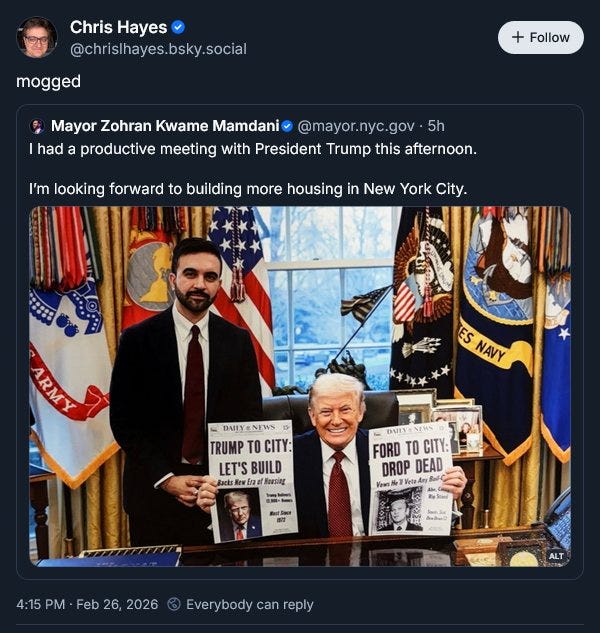
Like everyone else, I’ve been amazed at how New York City Mayor Zohran Mamdani has navigated his relationship with Donald Trump. In case you missed it, the mayor flattered Trump with a fake Daily News headline, and (in a single short meeting) got him to support (in principle) a huge, 12,000-unit NYC housing project and secure the release of Columbia University student Ellie Aghayeva, who was arrested by ICE agents in her own dorm, after the agents gained entry to the building by pretending to be NYC cops.
Here’s the photo:
The more I thought about it, the more I came to respect Mamdani, and reflect on what this moment means.
I have read some left-wing voices condemning Mamdani’s tactical embrace of Trump. But my sense is that they are in the minority, even among my more-progressive-than-I friends. A few months ago, Trump was calling Mamdani “a 100% Communist Lunatic” and a “proven and self professed JEW HATER,” and now, here they are, bros. And, more importantly, here’s Mamdani getting at least a yellow light for a massive public housing initiative (he was talking to a developer, after all) and securing the release of someone unjustly arrested by ICE.
Much has been made of Mamdani’s ability to manipulate Trump, and I agree with those takes. The guy knows how to flatter the dear leader, and it seems to work. Chris Hayes is right; Zohran’s totally mogging Trump here.
But what struck me most about this image — it reminded me of the famous Elvis-Nixon photograph, or Malcolm X meeting MLK — has been imagining what’s going through the mayor’s mind, and how it resonates with my own experience and the ways in which you and I might navigate the times in which we live.
First, I’m sure that even one year ago, Mamdani would have never imagined this moment happening, and that every fiber of his being would find it abhorrent as well as preposterous. This is Trump – the guy who banned Muslims from entry to the United States until the Supreme Court stopped it; the guy who has not only defended Bibi Netanyahu’s actions in Gaza but followed them up with a plan to ethnically cleanse most of the territory and replace Palestinian communities with high-end resorts; who unleashed ICE’s wave of terror; who defames Supreme Court justices; who… you get the point.
But Mamdani realizes that his role is different now. Like Henry V (to choose a perhaps grandiose analogue) he understands that he is no longer an upstart assemblyman or DSA organizer. He is the mayor of New York, and responsible for the wellbeing of eight million people. I am sure he has plenty of private feelings about Donald Trump (and his wife certainly has plenty about Gaza) but he puts those aside because a mayor has a job to do, and he is doing it.
Meanwhile, it is still the role of many other people to point out the horrible things, to to do everything in their power to defeat this man and his movement, and, if possible, to help keep vulnerable people safe. Mamdani himself, just days after the photo, condemned the war on Iran in stark terms. There is no one action that is correct for everyone all the time. We are parts of a political ecosystem, and we have different roles to play within it, at different times and positions.
This is a dynamic familiar to me. From 2003 to 2015, I worked as a professional LGBTQ activist, founding two grassroots Jewish organizations, writing a mainstream-focused book about the religious values that affirm the lives of queer people, speaking at over 100 events during the battles for same-sex marriage, and working for two funding organizations. I faced this question over and over again: What’s my lane? How am I positioned to make a difference? And what kind of difference do I want to make?
Before writing that mainstream book, God vs. Gay?, I outlined a much more radical book about sexuality and spirituality. At the time, I was active in the Body Electric School, the gay spirituality movement, the Radical Faeries, and the small community of scholars writing and thinking about queer theology. Yet, in 2010, I chose to focus on what activists call the “movable middle” — mainstream folks who were open to reconsidering their views. Much of my heart and mind was still more inspired by queer kabbalah and queer theology, but it felt like a moment of opportunity for the movement, and that I could make a contribution that I didn’t see other people making. (Several similar books have been written in the years since.) I did, and do, still write a bit of queer theology and queer kabbalah, and I never for a moment doubted the importance of more radical critiques of patriarchy, heteronormativity, and oppressive structures like traditional marriage. But in terms of focus, I made a choice. In my own much, much, much more modest way, I chose to be Mayor Mamdani rather than Organizer Mamdani. At least for a while.
In a way, it seems obvious that movements for change need many different kinds of activism. There have to be the protesters on the street, and the deal-makers in the conference room. There need to be radicals taking a stand and pragmatists working with the ‘other side.’ Greenpeace and the World Wildlife Fund. ACT-UP and HRC. Occupy and the Democratic Party (part of it, anyway). And now, frontline protesters on the streets of Minneapolis and lawyers fighting in the courts; sloganeering memes and think pieces; clear calls to conscience and pragmatic politicians who can actually win their elections.
But it is not obvious; in fact, many people disagree that both moderate and radical forms of activism are necessary, and these constituencies frequently loathe one another. The Hillary Democrats blame the Bernie Bros for ushering in the age of Trump in 2026 (I just blame the Standing Rock protesters) and the animus has not abated a decade later. DSA left-wingers blame the Democrats for being spineless, losing the working class by cozying up to the 1%, and enabling Israeli war crimes. It’s true in every social movement — the radicals and the insiders, the MLKs and Malcolm Xs.
And maybe I’m being pollyanish — too “Both/And.” Maybe my sense that there is a need for these different forms of politics stems simply from my own indecision, even in middle age, about where my sympathies lie (though like most old activists, I’ve moved more toward the mainstream as I’ve aged). Definitely many on the Left have accused me of being too incrementalist and accommodating to the Center (especially on Israel/Palestine), and many in the Center have accused me of being too friendly and accommodating to the Left (especially on Israel/Palestine). Sometimes one does have to make a choice.
Maybe — but I don’t think so. Would there be boring, assimilationist gay marriage without the radical gay activism of the post-Stonewall 1970s or the AIDS years? Obviously not. But had some of those activists not made the choice to put on suits and work within the system (even with the ‘enemy’), where would my family be now, in terms of rights and social acceptance?
When I look at the picture of Mamdani and Trump, I feel this view is validated. The question isn’t what kind of activism is ‘right.’ It’s what kind of activism is appropriate at what time, and what role you can play. Which Zohran can you be?
There are many vectors of this decision. There is the ideological one: liberal or radical, incremental or massive systemic change. There is one of venue: conference rooms or streets, negotiating tables or protest lines. There are choices between “being the change” — focusing on one’s individual behavior and choices — and focusing on systemic impact (I have been notorious about the latter). And there are questions of sustainability: what energizes you and what depletes you. For some, direct interaction is energizing; for me it is draining to even contemplate.
In a way, all this is a justice version of the famous and/or cliched Ikigai diagram (though here ‘what you can be paid for’ may be more ‘what is sustainable’):
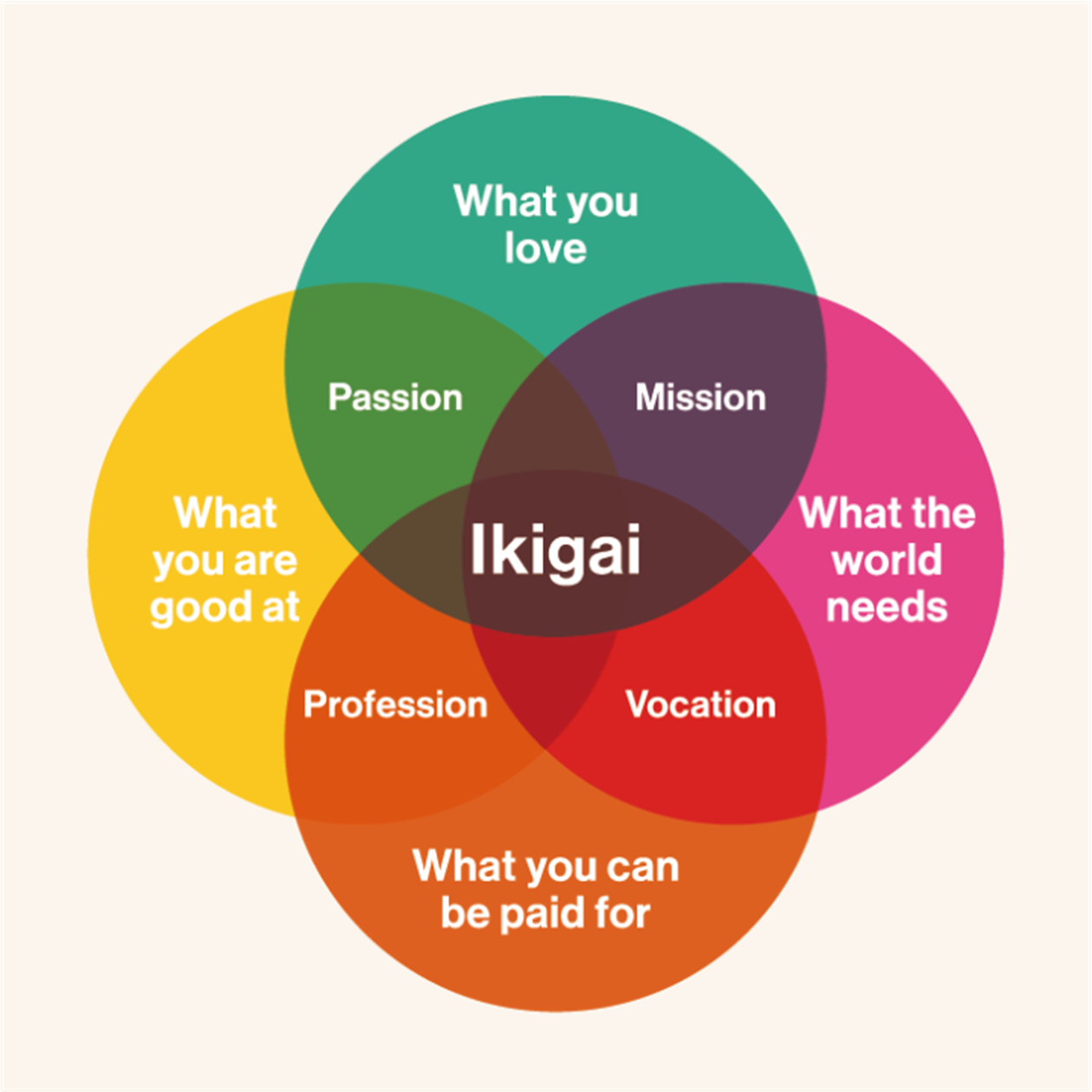
So, what about you? Are you energized by direct action? Helping a few vulnerable people — or focusing on larger, but more diffuse, forms of change? What about going go door-to-door doing deep canvassing or making the case for a cause you care about? How about sitting on a board and raising money? (And by the way, if you have lots of money, donating some of it definitely counts.) How are you wired? What are you good at? Where can you make a difference?
It’s not always neat. Would I prefer to be, I don’t know, Chris Hayes with a huge national platform, large salary, and impact two orders greater than my own? Sure, I guess. But do I have his work ethic, resilience, focus, and talent? Do I have his ability to speak to the mainstream in a way that feels authentic and direct? Not so much. I spend half my work time researching psychedelic spirituality, teaching meditation, and doing quirky Jewish work, not to mention co-raising my daughter and doing my own spiritual practice. And while I enjoy being a straightforward journalist — I was a Supreme Court columnist for five years, after all — I’m aware that I’ve always been a little too weird for that beat, even back in my CNN days. There are choices that I’ve made over the years, sacrificing impact and sustainability for what feels like authenticity and an unusual kind of balance. Sometimes the choices haven’t even been conscious ones; I’m trying to do better at that.
But we all contain multitudes. Tell me about yours. Which Zohran can you be in this moment of perilous change? What might be your place in the family of things?
Whoever you are, no matter how lonely,
the world offers itself to your imagination,
calls to you like the wild geese, harsh and exciting—
over and over announcing your place
in the family of things.
(Mary Oliver, of course)
Thanks for reading. Here’s some of what I’ve been reading online:
The best take on the Iran War I read this week comes from my friend Michael Shurkin . TW: It’s a downer.
DeSmog and The Guardian did an excellent report on ‘climate silence’ from Democrats and activists. I am guilty of this.
Another great article on post-liberalism from The Argument, this time on Carl Schmitt and his shocking level of newfound influence.
Will the Ellison family really control TikTok, CBS, CNN, Comedy Central, and the rest of Paramount and HBO? Robert Reich says our best hope of stopping them lies with state attorneys general.
If you’re a paid subscriber, thank you. If not, please accept my short pitch to upgrade. Both/And is just about sustainable at its current level: to build this up more will take more subscriber revenue. Your five bucks a month will make a difference — TIA. Or please pass my information on to the Ellisons.
I relate to this so deeply. One thing I'm coming to accept about myself is that I think some of the most effective people, in a moral , world-changing sense, have a single cause that transforms their lives, likely because of a personal experience. And I don't have that. But I have to believe that my ability to cross among different worlds and modes also brings its own unique value. And I know that yours does, very much!