


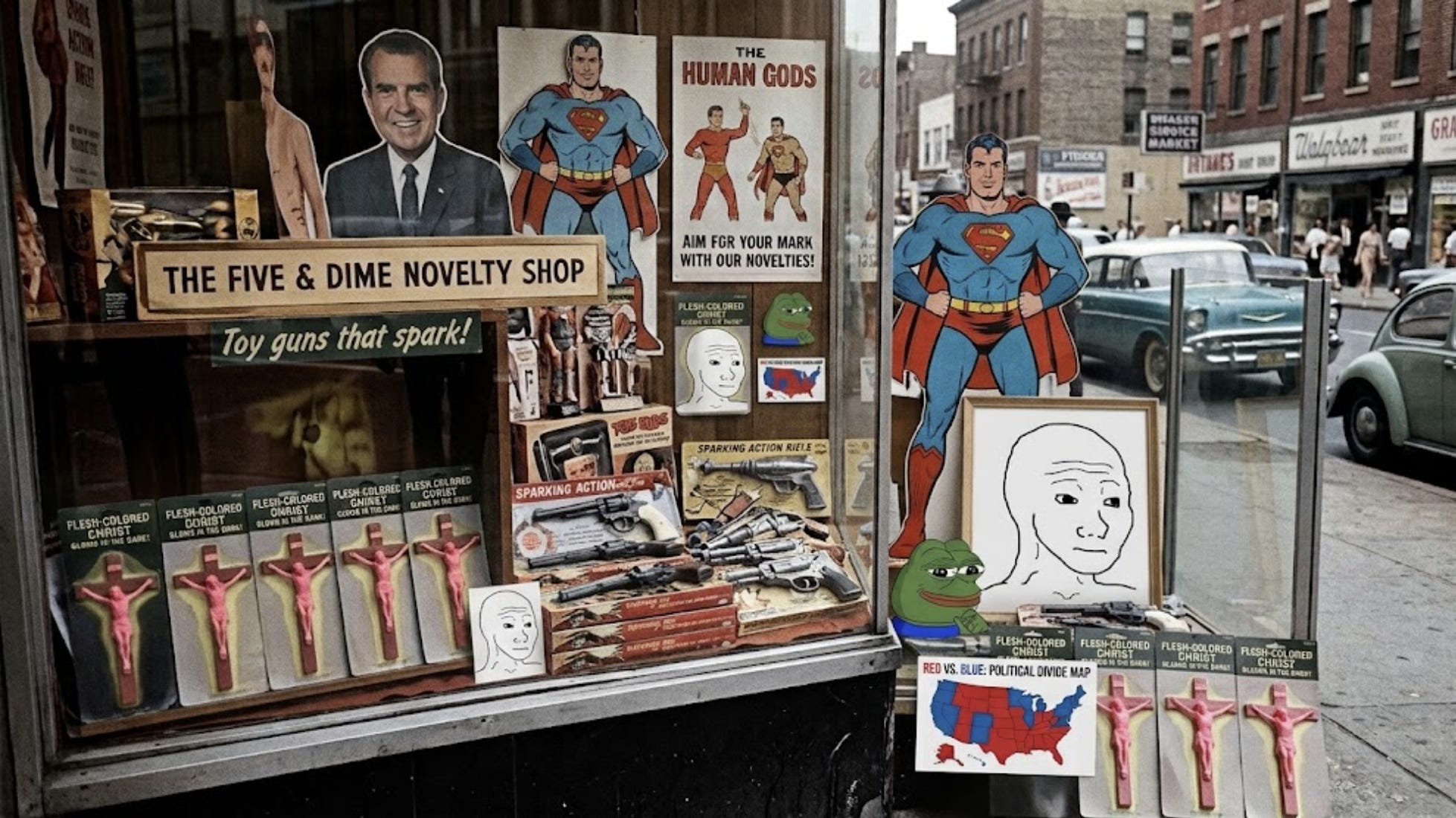
Two weeks ago, Sean Illing — podcaster (The Gray Area), columnist (Vox), and fellow Substacker — wrote a provocative piece describing politics as “The Dumbest Possible Religion.” After going over ground familiar to his readers and mine — the religion-shaped hole in American life and how politics (especially the shitty kind) has often filled that hole — Sean concluded by turning to his readers with a plea and some questions:
Almost everything I scribble these days amounts to a complaint about the shallowness of modern life. Not sure what the alternatives are supposed to look like at scale. People need what they need and I’m honestly out of ideas about where they’re supposed to get it.
I’ll throw it to you, since you’re the closest thing this blog has to a congregation: Where do you get yours? What’s a more healthy orientation to politics? Does politics as dumb religion sound vaguely right? Is there anything here worth exploring?
I was inspired to respond at some length, and to answer two of his questions: first, where I get my “alternatives to shallowness,” and second, whether politics is indeed “the dumbest possible religion.”
Alternatives to Shallowness
These are, of course, familiar topics to Both/And readers: I’ve written about the rise of nihilism, the meaning crisis, and how spirituality is limited in its capacity to provide meaning “at scale” even though it is central to my own experience of it. I’ve also agreed heartedly with Illing about the uniquely bizarre wedding of Nietzsche and Christianity that is pervasive on the modern Right.
As I’ve also written in these pages, one weird thing about my relationship to the meaning crisis is that I don’t personally experience it. As I wrote about at more length a few months ago, I have many generators of meaning in my life, some fairly common and some a bit more unusual. Such as:
1. A contemplative, mindfulness-informed perspective that, as corny as it sounds, provides quiet, resonant “moments of being” every day, with only a modicum of meditation practice (like, two seconds of it). Cf. Mary Oliver, Thoreau, Dzogchen, and this quote I love by writer Alan McGlashan:
Delight is the secret. And the secret is this: to grow quiet and listen; to stop thinking, stop moving, almost to stop breathing; to create an inner stillness in which, like mice in a deserted house, capacities and awarenesses too wayward and too fugitive for everyday use may delicately emerge.
Before I sound insufferable here, let me add that this isn’t because I’m exceptionally gifted — in fact, I’m just as restless as anyone else. But I’ve been fortunate/privileged to have had to chance to, in the odious corporate parlance of this decade, “optimized” for this capacity. I’ve gone on many long meditation retreats, taught meditation for twenty years, and I practice a little bit every day, usually in small moments, many times — sometimes with people special to me, sometimes with nature, sometimes just with awareness itself. Nothing special. Just makes my life feel worthwhile.
2. Religion, which is downstream from that. My Jewish practice is half-oriented around creating these moments for myself, my family and my community. It provides opportunities to experience the sacred (whatever that is) and to integrate them into the cycles of the week, the year, and human life. And it bonds me to a community, even though that community can also be crazy-making
3. What could be called “deep fun”: mysticism, sex, music, altered mind states, psychedelics. I’m not super into sports, travel, and various hobbies, but I am super into these things.
4. Family, friends, community, comings-together in various forms.
5. And making an impact through my work and activism. This is the other half of my Jewish practice: the part that responds to the experience of the sacred by trying to bring about more justice and compassion (cf. Abraham Joshua Heschel).
This, too, is not because I’m so virtuous. Rather, I experience this phenomenon as a combination of moral imperative and psychological compulsion. Sometimes I wish I didn’t give a shit as much; it often hurts. Sometimes I pendulate between engagement and withdrawal, as I’ve written about in this newsletter. But I am never happy if I’m not at least somewhat involved in what my tradition calls tikkun olam, repair of the world. It gave my life meaning when I worked for ten years as an LGBTQ activist, and it gives my life meaning now as a journalist, pundit, and psychedelics scholar. Thirty years ago, I went to law school to try and save the world; though that hasn’t panned out yet, the drive is still there.
To me, that leads inexorably to politics, which was Illing’s second question. Before I turn to that, though, I want to respond to the two trickiest words in Illing’s closing paragraphs: “at scale.” In that essay from a few months ago (entitled “Religion with a Lower-Case R”) I developed some of the stuff I’ve summarized here at more length, but also conceded that while progressive, non-dogmatic, even non-theistic religion and spirituality works so well for me, the religions that “scale” the best those that are more dogmatic, more in-group/out-group oriented, and more absolutist in terms of right and wrong.
This makes sense, if we treat them as memes (in the Dawkins sense, not the online one) that are naturally or culturally selected based on how successful they are at replicating themselves. It also makes sense if we reflect on how religion burrows itself into the deepest strata of the human heart and mind — what I called, in another essay, the “conundrum of religion.” Religion works because it does this: it activates our primal instincts for connection, consolation, and self-transcendence. It’s the original viral content. But because it does this, we often hold onto it tightly. We harm others because of it, we even kill for it. Precisely what makes religion “work” is what makes it so dangerous.
This is not to say that “religion with a lower case r” isn’t of value; I’ve written books about it, and it is at the center of my life. But I’m a weirdo. Notice, after all, what’s missing in my five sources of meaning: believing in a particular iteration of God, believing that my group is the best group, not to mention gaining status, getting rich, getting famous, having power over others, having a role in a communal system of meaning — a lot of the things that many (most?) people really value. So I don’t know if what I love will ever work at scale.
But let me turn to politics.
A Substitute for Religion, or an Expression of It?
Engaging with Dostoevsky, Camus, Nietzsche, and others, Illing voices some very relatable exasperation about how shitty politics is today. Illing writes, “Say what you will about the totalizing 20th century ideologies, they were at least internally consistent. They were systems that had to hang together.” But now, we just get vibes:
Modern politics is considerably stupider. I don’t know that there are any real ideologies anymore. We seem to have zipped past that stage of political history. No more grand theories of history, no highfalutin metaphysics. Nowadays you just have to get the vibes right. I know a slice of the online right is doing something approximating metaphysics (I wrote about it recently) but it’s downstream of maybe a few thousand people. By the time it reaches the rest of us it’s been thoroughly memeified.
(Side-note: I wonder about that characterization of the online right. Sometimes I really worry about Post-Liberalism, or Thielian Catholic-hyper-libertarianism, or Christian Nationalism. But at other times I agree with Illing that these ideologies are really only a few thousand people at NatCon. TBD, I guess.)
Here is where I think I disagree with Illing. I think it’s always been this way.
To Illing’s existentialist philosophers, I’d like to introduce the medieval Jewish rationalist Maimonides, and his twentieth-century conservative interpreter Leo Strauss. Maimonides understood that religion operates on multiple levels. People are different from one another; we vary in interests, in intelligence, in preferences. Maimonides is not a eugenicist: he wants everyone to be a philosopher. But he recognizes that not everyone wants to become one. Some people really aren’t interested, and spend their lives on things they find more meaningful: family, career, sports, whatever.
And so, for most people, religion is a set of beliefs about how the world is, inspiring stories, moral instruction, sources of consolation, and so on. And, says Maimonides, it is better to have it than not have it.
But philosophers understand that most of religion is nonsense — or, in Maimonidean-Buddhist terms, skillful means for communicating that which is hard to comprehend. Yes, the real God is incorporeal, infinite, and wholly unimaginable, but no one can relate to that. So religion creates the Biblical God, who seems like a strong, sometimes angry man in the sky. No, there’s no real grounding for ethics, so religion invents one. Nothing religion says is a lie, says Maimonides, but it does use a whole lot of allegory and figurative language. As Yann Martel put it in The Life of Pi, people prefer the version of the story with animals – that is, the mythification of psychology, philosophy, and mysticism. This is how humans are.
This kind of religion could be described as “dumb.” Taking myths literally, getting really worked up about the particulars of observance. But it is how the overwhelming majority of religious people understand themselves and their faith: Jesus really walked on the water, the Buddha really levitated, God is real and He (usually He) wrote the sacred text. In a way, this is dumb. But in another way, it is a human translation of that which is only of interest and comprehensible to a small minority of weirdos.
Politics, surely, is similar.
Smart politics may have something to do with Rawls or Montesquieu or even Milton Freedman, but, whatever its ideological valence, eventually it gets dumbed down to “jobs jobs jobs” and Trump’s AI memes. This is how democracy, the rule by the demos, has always been. Well before the internet, 19th century Americans were cajoled by slogans like “Tippecanoe and Tyler Too” and “Ma, Ma, Where’s my Pa — Gone to the White House, Ha Ha Ha.” There were supposedly sophisticated intellectual defenses of slavery, but there was also the brute racism and dehumanization that dictated the vast majority’s views about it. None of this is new.
Yet underneath even the dumbest of MAGA edgelord memes, there are real anxieties and real values at stake. Let’s not mistake the messenger for the heart of the message. Beneath the jokes are profound (and racist) fears that white people have about losing their cultural dominance, economic power, and social status. That may be evil, but it isn’t dumb.
The same, I think, is true on the Left. The performative, uber-woke, virtue-signaling self-righteousness is every bit as “dumb” as its right-wing counterparts. Yet underneath even the dumbest, worst example of far-left bullshit are some core commitments: human rights, equality, caring for the most vulnerable. These are also not dumb. Nor are the ways these politics-as-religions bring communities of care together and constitute forms of identity. I don’t mean to be relativistic or pollyannish here: I clearly have my side and I think the other side is ethically wrong. But I don’t agree that it’s new for politics-as-religion to be expressed in clumsy and superficial ways, or that it doesn’t have a non-dumb substrate.
In short, politics is not dumb religion. Religion can be dumb or smart, and politics-as-religion can be dumb or smart. But just a short distance upstream from the dumb is usually something that isn’t dumb: core values, core myths, and core fears. Even flesh-colored Christs that glow in the dark have a mythic, psychological meaning behind them; and so do the NRA’s guns that spark.
I’m not sure that politics is as pervasive as Illing says it is (“Political identity seems to be the primary cultural marker in American life right now.) I think a majority of Americans don’t really care about it; in fact, I wish they cared more. But even the dumbest of red/blue divisions sit atop serious debates about what America even is. To most blues, it is a multicultural democracy based on core ideas and values, always deeply flawed but with the potential to be better. To a lot of reds, it is American culture, with whiteness and Christianity dominant within it like it was in the past: blood and soil and trucks. That’s not a dumb debate, even if it does get expressed in eight-second videos.
A Different Exasperation
Obviously, I share Illing’s exasperation with the stupidity of political “discourse” right now. But for a slightly different reason: the amount and asymmetry of bullshit.
For almost fifty years, the Republican Party has been lying to a majority of its voters, offering a combination of red-meat social issues and highly misleading American economics. The first ingredient means fearmongering about absolutely everything: Immigrant Crime, Illegals, Immigrant Caravans, DEI, CRT, Wokeism, Cancel Culture, Political Correctness, Affirmative Action, Welfare Mothers, Gay Marriage, Transgender People, Ebola, Inner City Crime, Communism, Socialism, Muslims, Groomers, you name it. And the second ingredient means American-sounding economics that actually translate into a windfall for the wealthiest: massively disproportionate tax cuts that starve the state while enriching its richest citizens, deregulation in the name of ‘free enterprise’, the abandonment of antitrust law, insanely pro-corporate fiscal and taxation policies, anti-labor practices that exacerbate the wealth gap, and a thousand other policies.
What a fucking con. Terrify white people with imaginary villains while robbing them blind — and then blame ‘elites’ for their economic woes. Thomas Frank’s What’s the Matter with Kansas? is still mostly true, as is Thomas Schaler’s more recent White Rural Rage. It’s not that the culture war is only a distraction, but it is partly that. You’ve got to hand it to the Reaganites: it’s a brilliant scheme.
So when I see the memes and rage-bait on the Right, I don’t see dumbness — that’s ever-present. I see a historically specific Reagan-Ailes-Trump con job that has turned this country into an oligarchy, and that is now embedded into American Christianity and non-urban American identity.
Honestly, I prefer the far-right memes. They’re honest: they want a white Christian America, and they say what they mean. That’s better than Fox News constantly terrifying and enraging its viewers with complete bullshit. Because immigrants are not stealing jobs, eating pets, or committing more crime than citizens, and what really is causing more economic hardship, social breakdown, and criminality are right-wing economic policies and budget cuts. If the GOP were actually making a dumbed-down case for oligarchy, that would be fine. But instead they just lie.
Politics has always been an arena in which real values are contested in dumb ways. Religion has too. And to the extent the former has come to replace the latter, I wonder if the change has really been so dramatic. For better and for worse, there are many ways in which human beings construct meaning within the existential nothingness that surrounds us. And ever since Marduk slew Tiamat (in the version with the animals), some of them have been dumber than others.
This was a pleasure to write — thanks to Sean Illing for inspiring it. Here’s some other stuff I enjoyed reading recently:
Substack’s most dogged exposure of the “great con” is probably Robert Reich, who writes about it almost every week. He recently did a great piece connecting the dots between wage stagnation and corporate greed; I recommend it. I wish I shared Reich’s optimism that relating these facts would make a difference.
The Times ran a great op-ed on the “Blame Reagan” theme I’ve developed here. I continue to believe this.
On the recent wave of AI doomerism (which I mostly share, actually), I recommend Benjamin Todd’s explainer of the Hugging Face hack. It’s easy for non-technical people to get swept away in either doomerism or denialism. Ben’s piece is nice and crunchy with some details that should be very alarming without being alarmist. If you haven’t yet, you should also read Stephen Witt’s column on this in the Times.
You probably don’t want to waste much time with the Natalie Harp scandal - she’s Trump’s weird fangirl aide maybe girlfriend. So I recommend reading Jeff Tiedrich’s hilarious piss-take on the whole thing, which includes all the details so you’re up to speed but with enough cussing and contempt to make it bearable.
Finally, I wrote a piece about the Macklemore Cancellation and then went on CNN to talk about it for fifteen seconds.
Thanks everyone; see you next week.
"making an impact through my work and activism....I experience this phenomenon as a combination of moral imperative and psychological compulsion. Sometimes I wish I didn’t give a shit as much; it often hurts...But I am never happy if I’m not at least somewhat involved in what my tradition calls tikkun olam, repair of the world." I feel you.
Great article - thank you, Jay! Appreciate the analysis of whether politics is truly a dumb form of religion and also love your list of Alternatives to Shallowness, many of which I relate to, including the commitment to tikkun olam (which I also recently wrote about :)) I see each item in the list as a different mechanism for self-transcendence, which is so important because, in my humble opinion :), much of the shallowness of modern life stems from the fact we, as individuals and a culture, are very self-focused.