


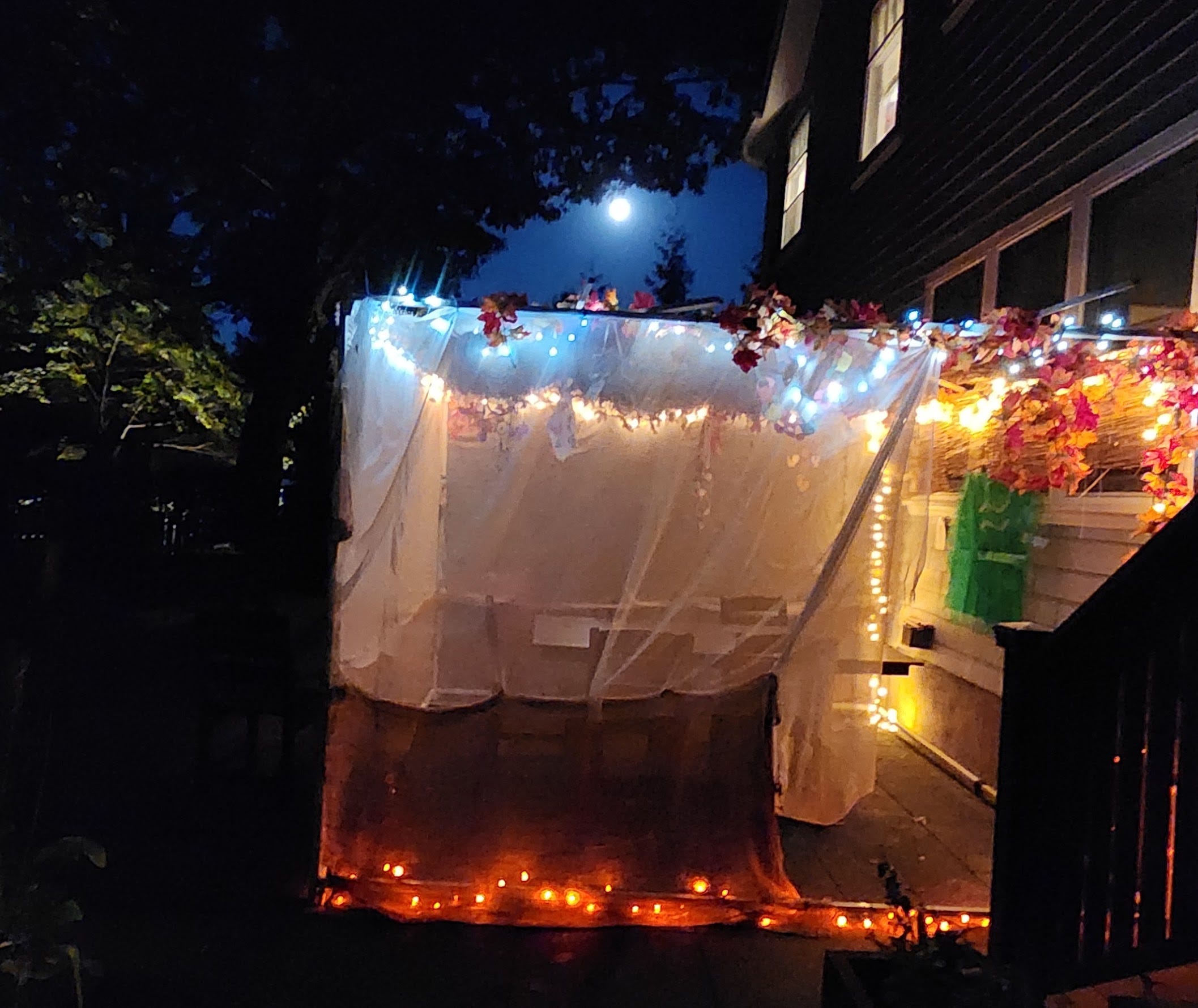
Sukkot, the Jewish holiday taking place this week, has long been my favorite. It’s peculiar, pagan, and mostly free from problematic theology. It’s observed mostly at home, or rather, in temporary huts that religious Jews build for a week. And it operates almost entirely on the level of myth, psychology, ritual, and symbol: the parts of religion I love, without dubious explanations and attempts at sense-making. As such, It’s a kind of microcosm for my longtime religious practice, which for twenty years has been suspended between belief and unbelief, mysticism and doubt.
Naturally, this being Both/And, I am dissatisfied with the partisans on either side of these dichotomies.
Skeptics, atheists, and materialists often, it seems to me, discount the pervasiveness of religious consciousness too quickly, reducing it to neurology or pop psychology – which could just as easily be done to love, grief, or, for that matter, the sense of a thing being right, the foundation of skepticism itself. Is that not, too, just a feeling in the brain?
Yet believers — and here I mean not fundamentalists or fideists, who I do not regard as intellectually serious, but contemplatives and mystics as well — often jump too quickly from religious experience to religious ontology. Popular writers like David Brooks and Liz Bruenig glide effortlessly from a pleasant spiritual experience — feeling a warm breeze, looking into the eyes of a child — to an ontological-theological assertion of the existence of God, or at least the Sacred. If skepticism is too hard, this kind of spirituality is too easy. Surely more discernment is needed before one moves from how things feel to how they really are. The experience of mysticism, let alone spirituality, does not prove anything.
As for traditionalists, the more I hear religious people talk about religion, the less I have in common with them. I have no intellectual belief that an anthropomorphic (and usually male) deity exists, let alone wrote this sacred text but not that one, or continues to be involved in the daily lives of seven billion people (or at least the percentage of those beings who believe in Him correctly). I do not believe this deity metes out rewards and punishments, or that there is a heaven or hell in any conventional sense, or that the events recorded in the Bible or other sacred texts happened as described; these texts are myths, not histories, and no more or less true than others. I do not believe that a deity or scripture gives my life some kind of objective meaning or purpose, though of course I experience them subjectively.
As a rabbi, I feel like I have traditional beliefs projected onto me, and I sometimes wish I could wear a badge letting people know that I don’t hold them. As one of my core teachers, Rabbi Zalman Schachter-Shalomi, used to say to atheists and agnostics: I don’t believe in the same God you don’t believe in. Or scripture, or pseudo-history, or ethnocentrism.
But I do “believe” in some kind of God. I experience moments of proximity to Being-Consciousness-Bliss (sat-chit-ananda), both in profound peak experiences and in everyday moments of being. I know the experience of the sacred, though it’s hard to put into words, and I love it. I orient my life around and toward it. Sometimes there are peak experiences of mysticism and ego death, other times there are the fireworks of entities and synchronicities, and sometimes ‘only’ the ineffable presence of awareness or the quiet breeze of the sacred in the midst of ordinary life. I also experience a sense of rightness when I see or express compassion, justice, love, truth, and empathy, and a sense of wrongness when I witness cruelty, destruction, hate, ignorance, lies, and the causing of suffering.
These feel like ultimate concerns, to use Paul Tillich’s language; they seem to lie beneath all my other commitments. They are not tied to any specific iteration – that is for conversation, reflection, and even debate. And often, they lead away from religion rather than toward it – whatever “God” is, it must be closely related to truth, and so that which is not true must be set down, however reluctantly. Skepticism, science, criticism, questioning, and discernment are thus all servants of the One.
This does not mean I seek to minimize or explain away the sacred texts of previous generations, in my traditions or any other one. Quite the contrary. Last month, I, like many Jews, read the devotional liturgy of Rosh Hashanah and Yom Kippur, filled with fear and awe and repentance. As I’ve written elsewhere, not only do I not “believe in” the theologies behind these texts, I often experience those theologies as harmful to myself and to the world. But I still want to imagine, and if possible imaginatively experience, the consciousness that lies behind them. Something real and powerful created these myths and wrote these hymns and poems. I don’t inhabit the same conceptual world as their authors, but I do want to visit them, as a practice of spiritual imagination. And there is something profoundly right about experiencing the fragility of our human lives and the frailty of our morality. We fall short; this is how humans are.
Religious myth is a narrative presentation of profound psychological truths. The narratives may be “false” as a matter of history, ontology, or theology, but the inner realities that they convey are very real. As Yann Martel put it in The Life of Pi, religion is the “story with the animals” — the version of our psychological journeys that is conveyed and brought to life in narrative. Of course, traditional religionists believe those narratives as literally presented, and I do not. But Hamlet may not have happened historically either. Arjuna, Hecate, Lao Tse, Moses may never have historically existed. But why does that matter?
Sukkot, in its pagan peculiarity, resonates the most (or clashes the least) with this conception of religion. It lays bare the historical development of Judaism more overtly than any other holiday: obviously, this is an agricultural harvest festival — Chag Ha’Asif, the festival of the ingathering, as it is referred to in Exodus and Leviticus. Passover and Shavuot have these roots as well: Passover is the spring festival when the rains stop and the beginning of the barley harvest, and Shavuot is the beginning of the wheat harvest and the picking of the first fruits. But they are more heavily layered over with later strata of Jewish myth, namely the exodus from Egypt and the giving of the Torah.
Sukkot has these strata too, but they are flimsier and more secondary. Primarily, this is the shamanic festival when Jews gather four sacred plants together and wave them in the six directions. We dwell (or at least eat) in temporary huts that evoke both the agricultural past and the precarity of the present. (This year in the Northeastern United States, the fragility of these huts was more real than usual, as most were destroyed in the recent Nor’Easter. I had to mostly rebuild mine.) None of this makes “sense” on an intellectual level, but I find it almost primordially sensible on an emotional and spiritual one. Yes, I want to say, this is how it is.
And there’s the practice of hoshanot, walking or dancing in circles, embodying the cyclicality of the seasons, as Robert Frost wrote:
We dance round in a ring and suppose,
But the Secret sits in the middle and knows.
What practice better reflects the inexplicable strangeness of the cycles of the seasons and the human life, how the rings accumulate like the layers of a tree, and who knows what it’s all about. It makes no sense, it makes all the sense.
In a perhaps odd juxtaposition, the traditional liturgy accompanying this practice is often about begging God for forgiveness. At times I’ve felt this to be yet another attempt to domesticate and sanitize the paganness of the holiday. But this year, as in other recent ones, I yearn to be able to beg for salvation. Do I intellectually believe that God is an entity who listens to prayer and answers it, sparing the righteous from peril? Not in the least — in fact, I don’t believe a single clause of that sentence. And not only because of the Holocaust (though partly because of it). This is simply not the world I inhabit, and the tangles of illogic and pretzel logic necessary to harmonize it with the existential condition of being human seem, to me, so preposterous as to be religiously offensive. Divine Love could not possibly require such twisted intellectual rationalizations.
But even if I don’t believe in one, do I yearn for a Parent, a benevolent spirit, a unifying consciousness of the Universe, anything that could somehow, despite it all, save us from despotism, from technological ruin, from climate disaster, from the growing oppression by the most powerful. I bear this yearning without any hope of its being true. Every day brings further threats: just this week, our village idiot-demagogues in Washington met with leading AI executives, clearly not understanding an iota of what they were talking about or what the threats actually are. Here is one of the greatest crises we might face as a nation, and we have the least competent people in the world minding the store. Please, God, save us. Ana Adonai, hoshia na.
And in my own Jewish community, what I can only describe as a kind of collective traumatic psychosis has gripped many of our leaders, some perceiving existential threats of antisemitism where they simply do not exist, while others ignorie it where it clearly does (i.e. the Republican Party). We seem gripped in a maelstrom of fear and confusion and recrimination, which among other things distracts us from far more pressing political crises. Ana Elah, hoshia na.
And climate, and ICE’s hunting down of migrants, and the rule of law, and the wealth gap, and my health and my family’s, and decisions beyond my control, and human fragility — ana El na, hosha na, hoshia na.
At times, I wish I had the faith to leave the both/and of belief and unbelief, to plunge into religious assent. I imagine the consolation of knowing, or choosing to know, that Someone is watching over us, taking care of us. I yearn to be able to yearn in this way – to finally release into faith. But this is not the brain, body, or heart I inhabit. Perhaps my peak experiences are still not peak enough, though they have been, while they last, utterly definitive: Is is all there is. But then, the return to the kitchen, the car, the bus stop. The ratza v’shov back to the supermarket and the newspaper. And uncertainty returns.
There are consolations of uncertainty. I know that because I do not know, I am less likely to impose my certainty on others; not only am I unlikely to be a traditional fundamentalist, but I am also less likely to be an evangelist of psychedelic or ‘evolutionary’ or ‘emergent’ spirituality, which is less oppressive but at times similarly zealous. And I take consolation from the both/and polarity of knowing and unknowing: that we know, and yet we know that we do not know. And that the great mystics all agree that there is simultaneously an Answer and no answer.
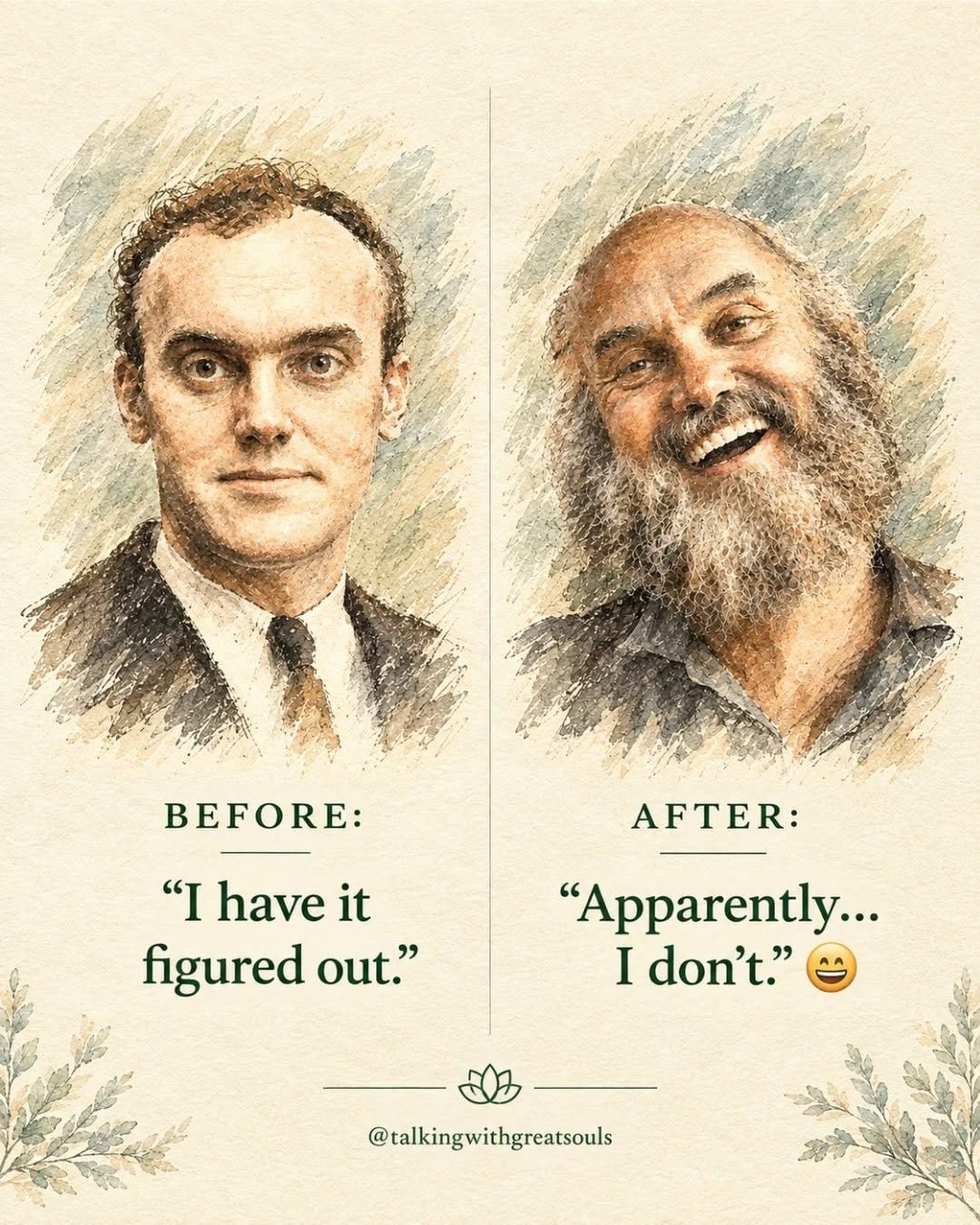
The faith I have is not in the ontological correlates of the spiritual experience, but in the emotive and embodied quality of the sacred. As the poet Christian Wiman said (in a sentence I quoted last week and am still thinking about), “faith is about being faithful to the times at which you felt faith.”
Yes. At those times, which are accessible now, there is a kind of knowing that coexists peacefully with unknowing, and as Heschel taught, compassion emerges naturally from it. (If it doesn’t, ‘it’ isn’t it.) And it is possible to be faithful to it — faithful to the way the heart was open at the times when the felt sense of the sacred was rich. And faithful in the sense of committing to cultivate such moments of being (in Virginia Woolf’s terms) intentionally, often irrationally, like waving magical plants in the six directions. The Sukkah itself seems to embody this suspension: it is a temporary structure, only lasting for a moment, yet inside it, mystery dwells.
No conclusions are drawn from this practice — only a momentary thawing of the heart. Although if you like, I could tell you the version with the animals.
Thanks for reading.
A few other Jay things this week:
I wrote about the renewed relevance of religion in the age of AI for the Forward.
My interview on the Religion on the Mind podcast is now online (an excerpt is below).
I’ll be part of the University of Wisconsin’s Psychedelic Symposium on October 30 — I’ve been working on my talk this week…
And some recommended reading:
Term of the week: “Meat Proxy.” (Courtesy of Jake Handy )
In some less-reported news, Jack Smith, who came close to bringing Donald Trump to justice, was grilled by Republicans but came out looking smart, non-corrupt, and courageous. Michelangelo Signorile did a nice job with the coverage.
John Ganz wrote a great piece on a subject I’ve pondered in these pages: whether conservative intellectuals are actually thinking anything, or just legitimizing prejudiced and reprehensible beliefs.
Finally, I kind of loved this presentation, shared by Eugene Healey, on the evolution of Cool in the age of the algorithm. Fascinating.
See you next week. If you’re in the Hebrew tribe, please enjoy waving your Lulav and don’t forget to beat the willows on the ground five times tomorrow morning. Because we Jews are definitely not earth-based, goddess-venerating, crunchy pagan witches at heart.

The thaw to refreeze to thaw I inhabit. I, too, yearn for a smoother ride.
I call myself Spinozan. I don't believe in God, but I do believe in miracles.